ExoMBridge
Independent molecular research by Filippo D. Galbo
Research preprint ·
EEF1A2 D91N and the GDP-binding site
During minimization, the shortest distance from residue 91 to GDP increased from 4.81 to 5.75 Å in wild type. In D91N it stayed near 4.85 Å.
The ExoMBridge workbench
From molecular inputs to saved results.
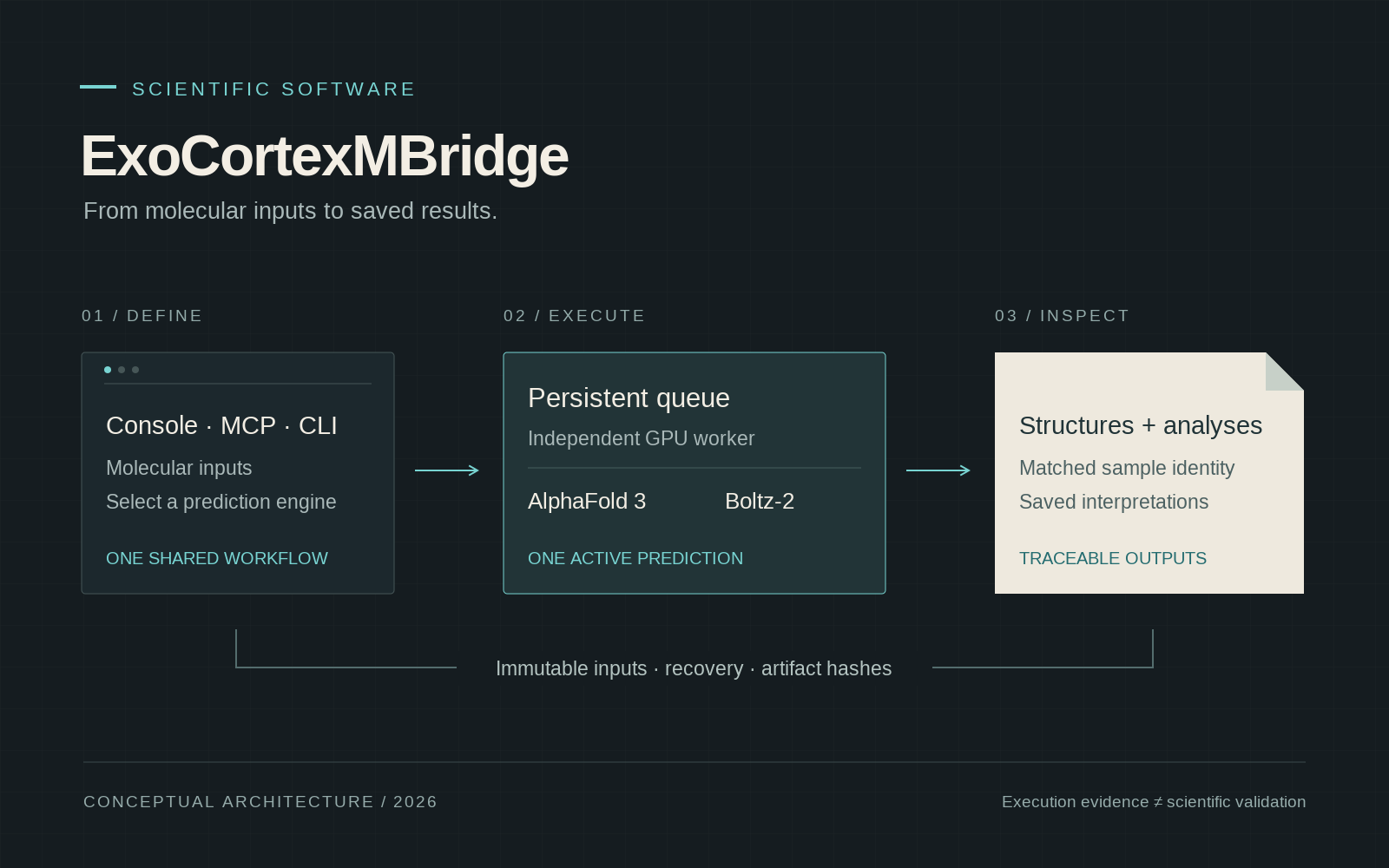
ExoMBridge is an independent computational molecular biology workbench developed by Filippo D. Galbo, previously presented here as ExoCortexMBridge. It connects AlphaFold 3 and Boltz-2 to a local interface for submitting inputs, viewing structures, and comparing results. Each saved prediction includes the inputs and settings used to produce it.
The work is independent and noncommercial. I connect biological question framing, controlled inputs, execution accounting, structural interpretation, and research communication, with documented AI assistance in software and analytical work. The application remains private; reviewed study outputs are public.
Long-running jobs can be recovered after an interruption. Structure measurements and reference comparisons are saved alongside the model output, so I can return to an earlier result without reconstructing the run by hand.
Earlier structural study · 12 November 2026
EEF1A2 D91N: proximity and geometry.
The earlier study compared six Boltz-2 predictions for WT, D91N and D252H at two seeds. One D91N distance contrast persisted across seeds and the other reversed. The archive includes the six models and their 24 native confidence files.
A possible protein development workflow
From a proposed protein to a testable design.
A researcher or protein design tool can supply candidate sequences for a protein intended to bind a target. ExoMBridge could help evaluate those proposals by running predictions, comparing structures and contacts, and keeping each input with its results. Laboratory experiments still determine whether the protein folds, binds its target, and performs its intended function.

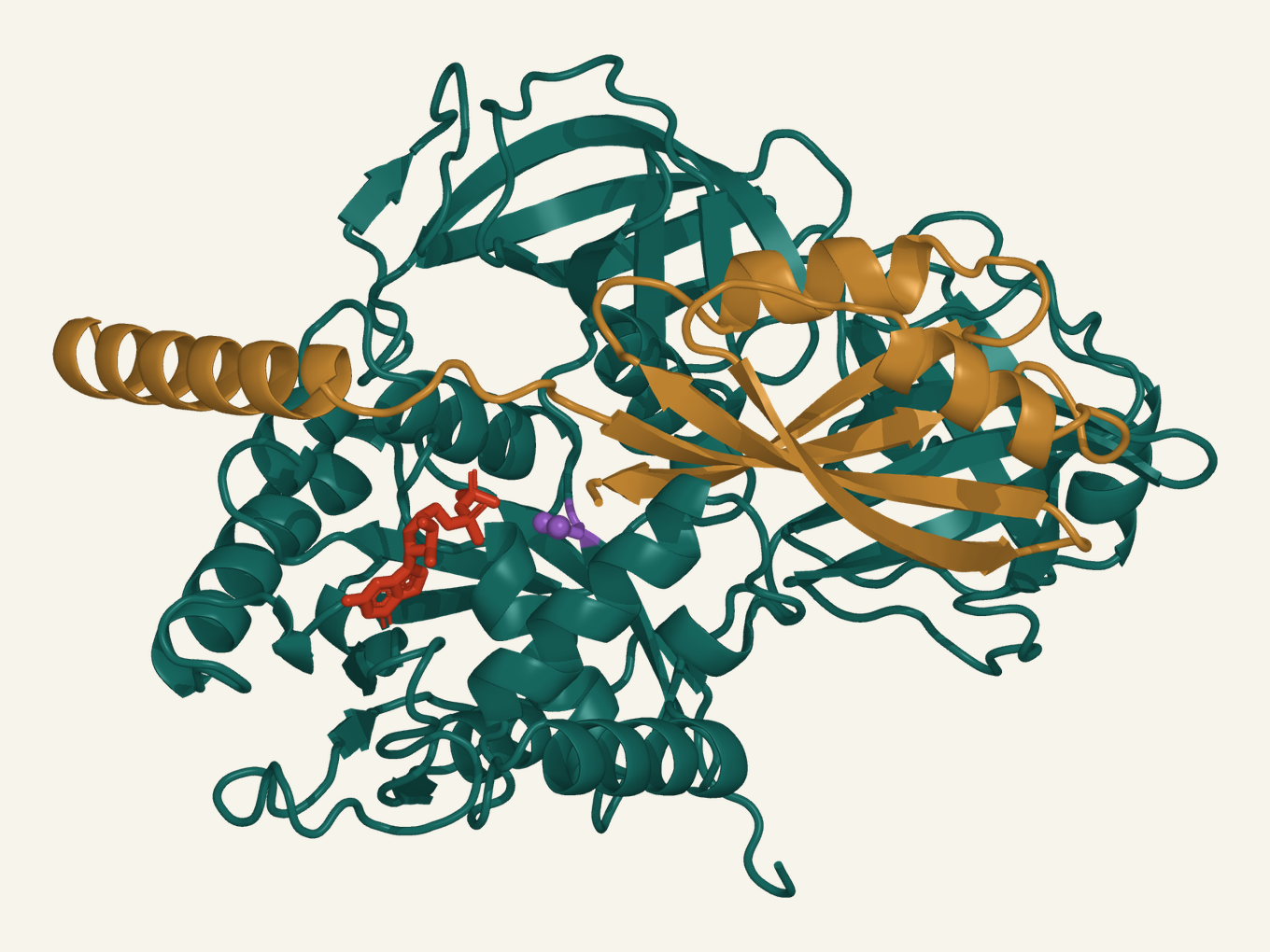
This published experimental structure illustrates what a designed protein bound to its target can look like. Bim_fulldiff (chain A) and a BIM peptide segment (chain B) are shown from biological assembly 1 of PDB 8T5E. The structure comes from Vázquez Torres et al., “De novo design of high-affinity binders of bioactive helical peptides,” Nature 626, 435–442 (2024).
The rendering and contact analysis were performed locally using that public reference structure. Highlighted residues have a non-hydrogen atom within 4.5 Å of the other chain. This is spatial proximity, not a measurement of binding strength. The structure is from the published study; it is not an ExoMBridge prediction or a design produced by this project.
Public reference data
Reference-data check
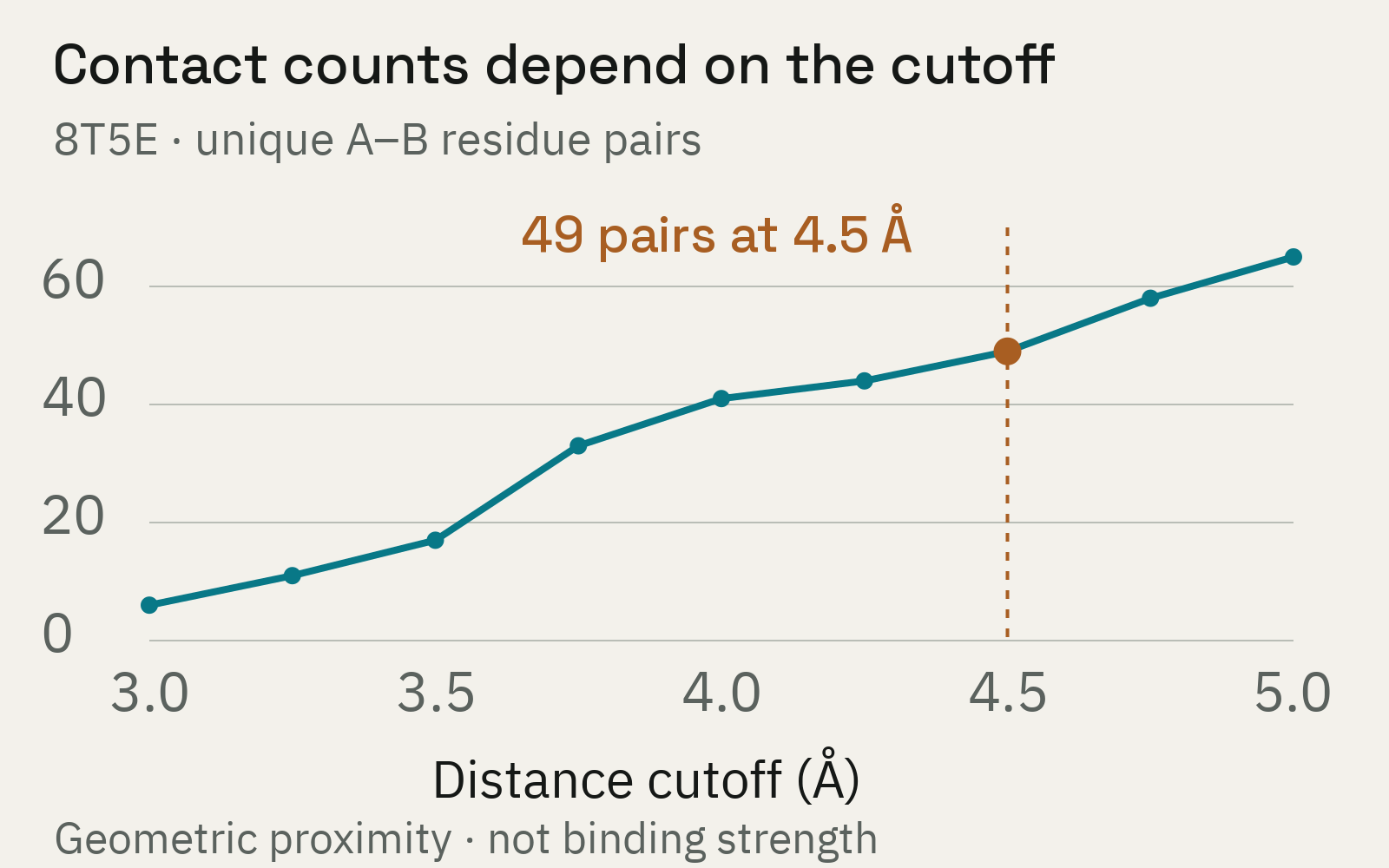
Contact counts depend on the chosen distance cutoff. At 4.5 Å, this analysis of chains A and B finds 261 non-hydrogen atom pairs across 49 residue pairs. The plot shows how the residue-pair count changes with the cutoff.
An independent distance calculation reproduced the contacts, and rotating and translating both chains together preserved them. These checks test calculation consistency. They do not establish binding strength or the success of a new design.
Public inputs and analysis downloads
An earlier test run completed eight predictions across four molecular fixtures on September 23, 2026. These pilots tested job execution and the integrity of saved files. They do not establish biological validity, calibrated binding affinity, or clinical utility; computational seeds are not biological replicates.