ExoMBridge · EEF1A2 D91N walkthrough
Does the D91N geometry repeat at a second seed?
Follow the inputs and two atom-pair measurements from six EEF1A2 predictions. One D91N difference held its direction at the second seed. The other reversed.
Follow the inputs
Residue 91 sits near GDP and the exchange partner EEF1B2 in the model. The pilot asked whether two differences between D91N and wild type (WT) persisted when the prediction seed changed.
Each input contained full-length human EEF1A2 (chain A), full-length human EEF1B2 (chain B), one GDP and one magnesium ion. WT supplied the baseline and D252H served as a comparator. Boltz-2 generated one model for each of the three conditions at seeds 11 and 23. ExoMBridge tracked the inputs, retained models and analysis records.
WT at seed 11 used an earlier raw sequence alignment. The methods record identifies which alignment features were checked for equivalence. The subject map connects each model to its condition, seed and confidence files.
Compare each variant with WT at the same seed
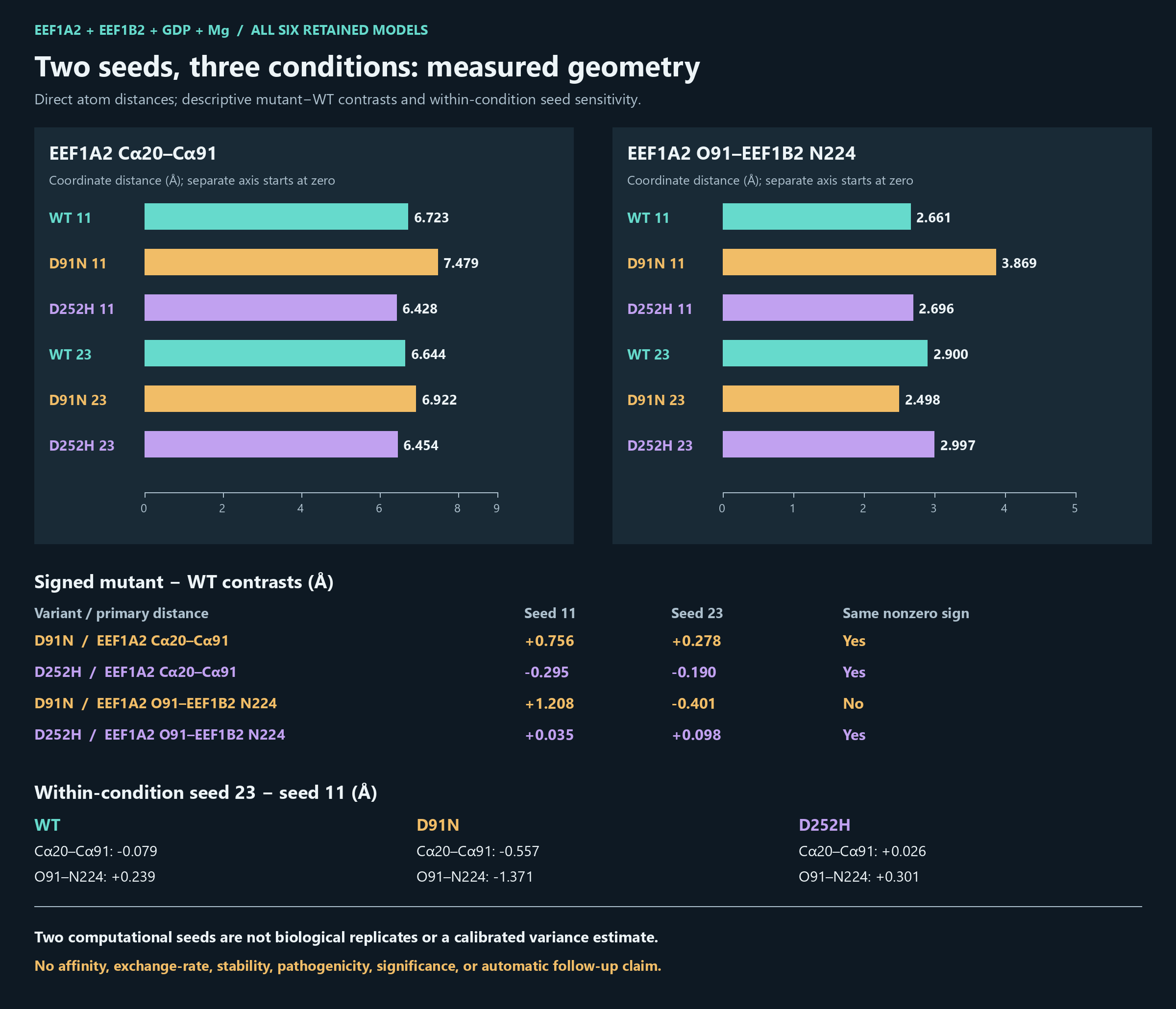
The study specified both distances before seed 23. The first connects the Cα atoms at residues 20 and 91 within EEF1A2. The second spans the backbone oxygen of EEF1A2 residue 91 and the backbone nitrogen of EEF1B2 residue 224. A positive difference means the atoms were farther apart in the variant than in matched WT.
| Variant and atom pair | Seed 11 | Seed 23 |
|---|---|---|
| D91N EEF1A2 Cα20–Cα91 | +0.756 | +0.278 |
| D252H EEF1A2 Cα20–Cα91 | -0.295 | -0.190 |
| D91N EEF1A2 O91–EEF1B2 N224 | +1.208 | -0.401 |
| D252H EEF1A2 O91–EEF1B2 N224 | +0.035 | +0.098 |
D91N’s within-chain distance was longer at both seeds. Its cross-chain difference reversed direction. The two distances therefore give a mixed result. Both D252H contrasts kept their signs, but its cross-chain contrasts were smaller than its own change between seeds.
What remains open
The two computational seeds test sensitivity to seed choice. This report contains six static predictions, with no biological replicates or molecular-dynamics trajectories. Distances and model confidence cannot establish binding affinity, protein stability, nucleotide-exchange kinetics or pathogenicity.
Whether D91N changes EEF1B2-stimulated GDP release remains an experimental question. Testing it requires comparing WT and D91N at matched concentrations of soluble, nucleotide-competent EEF1A2.