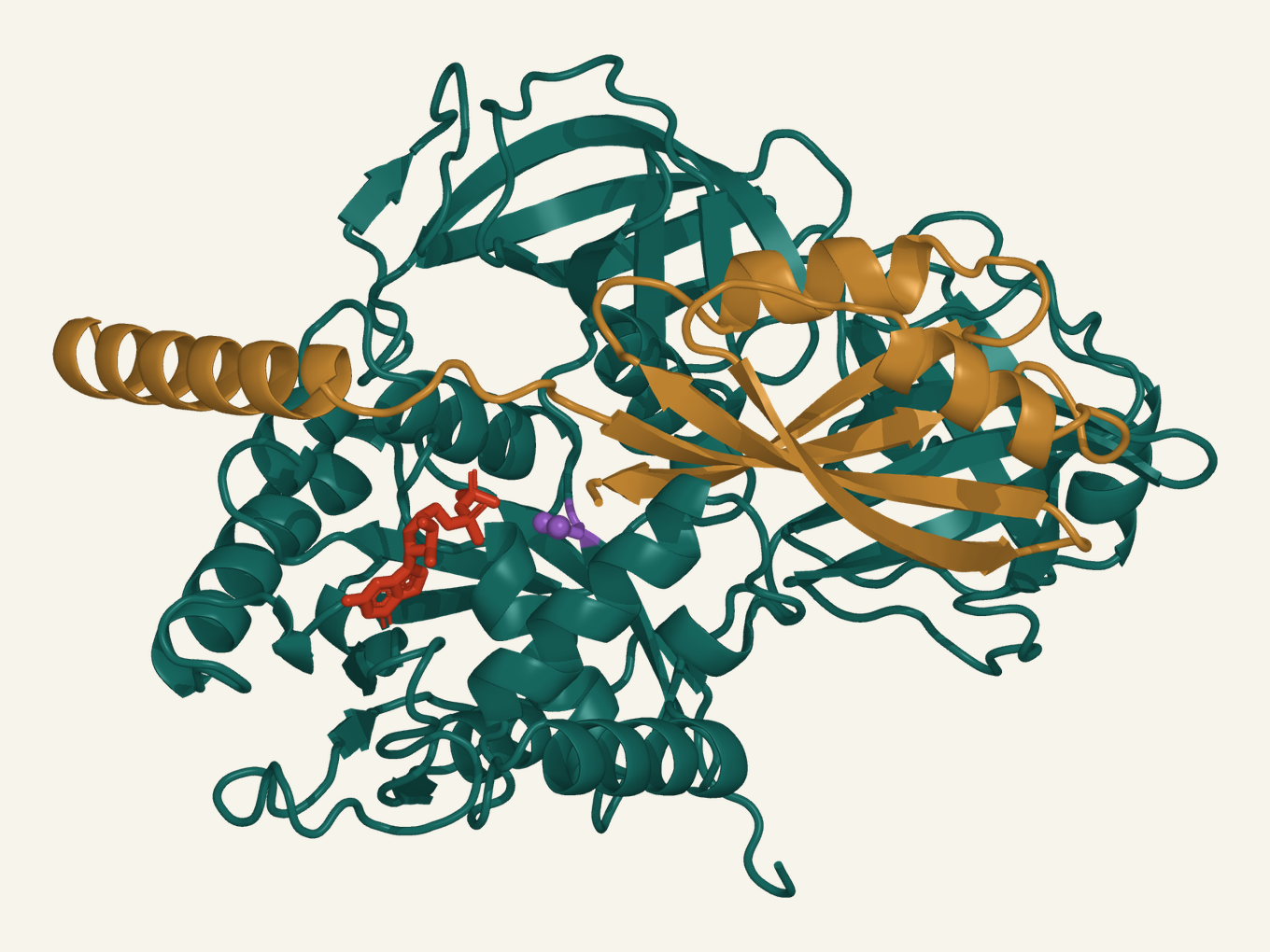
EEF1A2 D91NGeometry in a modeled complex with EEF1B2 and GDP
When does a single amino acid substitution change the distance to GDP? In this model, the difference was already present before production dynamics began.
Principal finding
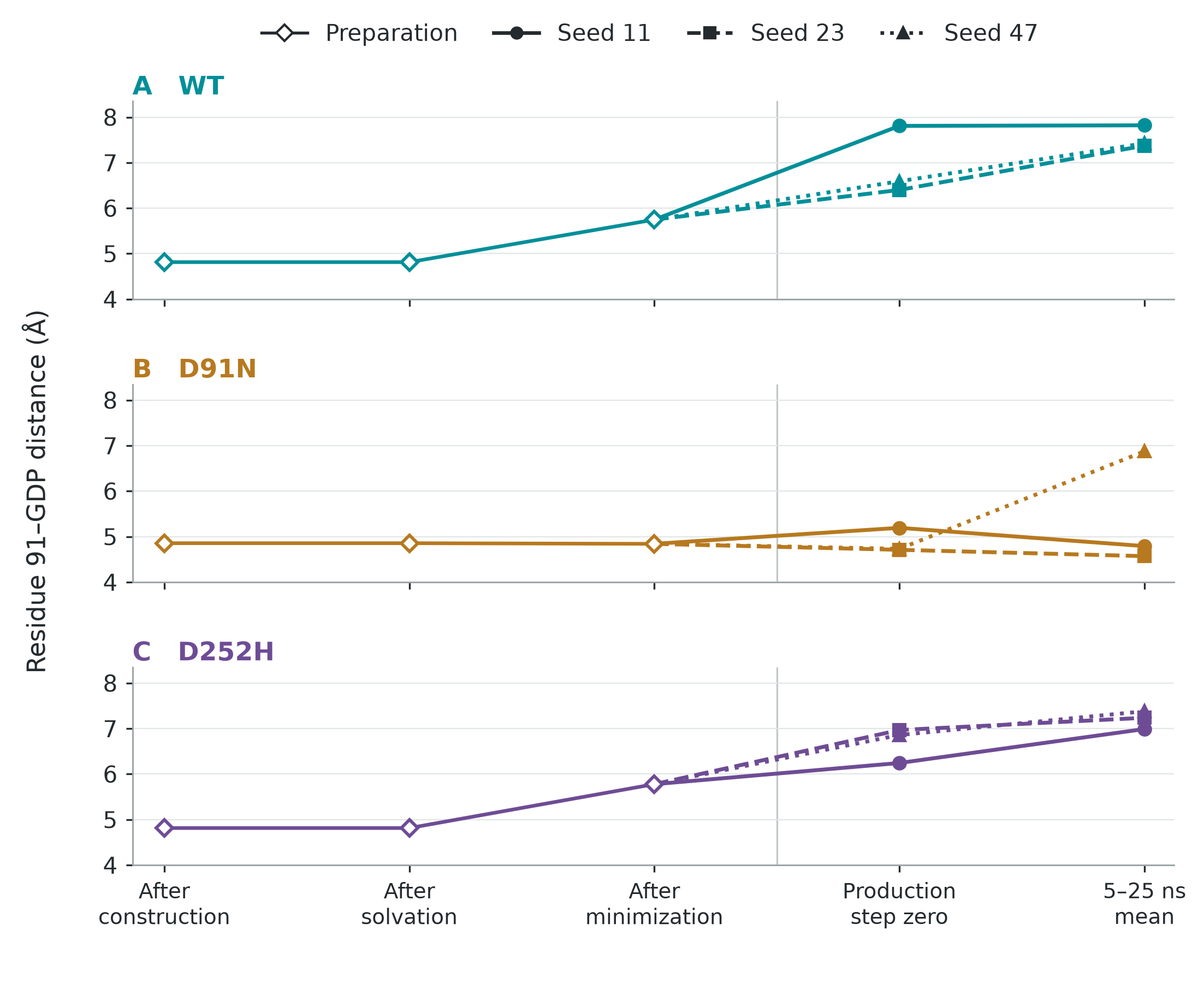
The distance changed most in wild type.
Before minimization, residue 91 lay at nearly the same distance from GDP in WT and D91N. During minimization the WT minimum increased by 0.93 Å. The D91N minimum changed by less than 0.02 Å.
The same GDP phosphate oxygen was closest in both structures. In WT, the nearest Asp91 oxygen changed from OD2 to OD1. In D91N, Asn91 ND2 remained closest through minimization.
| Condition | Solvated | Minimized |
|---|---|---|
| WT | 4.81 Å | 5.75 Å |
| D91N | 4.85 Å | 4.84 Å |
Each value is the shortest of 224 heavy-atom pairs. A change in their separation does not identify which atom moved.
Study design
From a shared scaffold to nine trajectories
The main study compared WT, D91N and the D252H comparator. Each condition started from the same WT-derived protein scaffold with a condition-specific preparation, a fragment of EEF1B2, and GDP without magnesium.
Three velocity seeds per condition each produced 25 ns of dynamics. Over the 5–25 ns window, the mean minimum distance was 5.4 Å in D91N and 7.5 Å in WT. The six earlier predictions and the three magnesium-containing pilot runs are reported separately.
Water bridges
Two runs shared a water-mediated contact.
In two D91N trajectories, a water molecule bridged Asn91 and GDP in 97 and 122 of 201 saved frames. In the third, Asn91 changed side-chain orientation before 0.6 ns. That run had zero qualifying bridges in the 5–25 ns window.
What remains open
These are observations of molecular geometry in one prepared model. The simulations did not measure GDP release. The functional question is whether D91N changes basal or EEF1B2-stimulated release when WT and D91N are compared at matched concentrations of active protein.
Paper & data
Read and reproduce the study.
The paper and supplement contain the full methods, all primary endpoints and the limits of the comparison. The reading packet includes the named atom pairs from every audited checkpoint.
Word manuscriptClean MarkdownFile checksumsMain study verificationPilot verification
- ManuscriptFull preprint with three figures and three tablesPDF
- Supplementary materialFour tables and the trajectory running meansPDF
- Complete reading packetPaper, editable sources, supplement, figures and atom-pair replayZIP
- Main study analysisOriginal scalar series, topologies, atom maps and replay code · 85.4 MBZIP
- Predictions and magnesium pilotSix predictions, sequence alignments and pilot measurements · 40.8 MBZIP
Main study trajectories · Mg-free
Pilot trajectories · Mg-containing
Extract the nine main ZIPs and the state-A analysis ZIP into one empty directory named data, allowing their folders to merge. For the pilot, decompress the D91N gzip file once to restore its ZIP, then keep all three pilot ZIPs intact.
Use the download manifest to check each file’s SHA-256 and restore its directory path. Verify the restored files against the deposit checksums. The complete GitHub release includes the replay instructions.